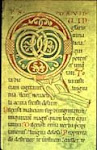
Heu Mihi inquired yesterday what I thought about the affiliation of Helfta (Cistercian or Benedictine). I confess I hadn't much thought about the affiliation of Helfta before that point, so I poked around a little.
As it turns out, Helfta is interestingly eclectic in its spiritual affiliations and influences. This Saxon community of nuns was founded c. 1229. According to an article I recently read in Meredith Parsons Lillich, ed., Cistercian Nuns and their World, there's a definitely-Cistercian community that served as their mother house. It's not clear to me that this was a particularly strong link, mind you. Helfta was apparently never officially incorporated into the Cistercian Order, which leads some scholars to call it simply Benedictine; yet they did adopt some Cistercian customs.
So, do they walk, talk, and act like Cistercians? Sort of. They appear to be influenced by Cistercian spirituality, as discussed in Caroline Walker Bynum, Jesus as Mother. Yet according to several authorities, their spiritual advisors in the late 13th century were Dominican and/or Franciscan, possibly out of shared interests in mysticism. They thus appear to have accepted spiritual advice from many different sources and traditions. Their institutional commitment to learning is distinctive; I suspect most women's communities following Cistercian customs did not emphasize the trivium and quadrivium to the extent that Helfta's nuns did. And the Helfta nuns develop some original and distinctive devotions, such as devotion to the Sacred Heart. Rosalynn Voaden, in an essay in Medieval women in their communities, argues that the Helfta visionaries worked closely together and influenced each other, and has an interesting discussion of the Sacred Heart.
So, to sum up, Helfta is idiosyncratic; certainly following the Benedictine rule and Cistercian observances, although not officially recognized as Cistercian. The lack of oversight from a Cistercian father abbot may in fact have been helpful to them, allowing them greater autonomy in selecting spiritual guides and forging their unique community culture.
Showing posts with label Cistercians. Show all posts
Showing posts with label Cistercians. Show all posts
Friday, November 14, 2008

Thursday, November 13, 2008
Bits and pieces
So. Incremental progress today. The job applications are done, so I hope I can get back into a groove of writing / researching more regularly. Today I read a few articles and made notes toward some pending revisions. I am returning now to some of the issues I raised in this post. Specifically, I'm reading up on various debates about the early existence of Cistercian nuns. I have to say that the need to address all of the major arguments on this subject seems a little tiresome. Newer arguments that favor the existence of women's communities that believed themselves to be Cistercian seem much more compelling than older pieces' simple assertion that there were no early Cistercian nuns. I am much in favor of observing realities on the ground: if people act like Cistercians, look like Cistercians, and talk like Cistercians, I tend to think they're Cistercians.
I am paying particular attention to references to Spain, of course. There's a Navarrese community of Cistercian nuns called Tulebras which appears to have had some influence both into Aragon and into Castile, but it's difficult to find out much about it. My initial searches haven't turned up much, and the community is not usually mentioned among the standard lists of early Cistercian nunnieres (Jully, Tart, etc.). I seem to have identified yet another topic that could use more research...
I am paying particular attention to references to Spain, of course. There's a Navarrese community of Cistercian nuns called Tulebras which appears to have had some influence both into Aragon and into Castile, but it's difficult to find out much about it. My initial searches haven't turned up much, and the community is not usually mentioned among the standard lists of early Cistercian nunnieres (Jully, Tart, etc.). I seem to have identified yet another topic that could use more research...
Thursday, September 25, 2008
Cistercian nuns in Catalonia
I've been dabbling the last few days in scholarship on Cistercian nuns, particularly on the topic of whether there were Cistercian nuns. Well, yes, there were, but the question is when they were, and how nuns became attached to the order.
The traditional narrative holds that the early Cistercians distanced themselves from women, except for a few leaders such as Stephen Harding and Bernard of Clairvaux who offered spiritual advice to religious women only informally. Then in the late 12th century, the clamor of women seeking places in monasteries, combined with other pressure, forced the Cistercian General Chapter reluctantly to admit houses of women to the order.
Probably the primary voice arguing against this narrative in Constance Berman's. In "Were There Twelfth-Century Cistercian Nuns?" (Church History 68:4, Dec. 1999, pp. 824-864) she attacks the question head-on, and connects it to her larger attacks on the traditional narrative of Cistercian origins found in The Cistercian Evolution. Berman's position is that the 12th-century expansion of the Cistercian order happened through groups of reforming hermits & monastics taking up Cistercian customs, and gradually being incorporated into the developing order (rather than new houses being seeded, so to speak, directly from Citeaux and Clairvaux). She further argues that many of these reforming groups included women, that such women viewed themselves as Cistercians, and that historians have applied overly rigid and anachronistic standards to dismiss many women's houses as only "imitating" Cistercians. She generally argues that, where local records of a house having Cistercian customs conflict with the order's narrative sources, the local records should be trusted, because she considers the dating of the narratives to be highly questionable.
Now, Berman has her share of critics on these issues, but the material I am looking at inclines me toward her approach. I'm looking at material related to a Catalan nunnery (Santa Maria de Vallbona) which is presented as unambiguously Cistercian in the local historiography. Catalan historians often seem to blithely ignore historiographical debates focused on other regions--in fact no Catalan article related to Vallbona appears to cite any of this controversy, or the traditional narrative. But they do know their local sources quite well. In fact, the foundation story that appears in the multiple histories of Vallbona I've looked at fits Berman's pattern beautifully:
A charismatic hermit called Ramon settled down in the Good Valley of Vallbona, attracting a number of followers, both male and female. After some time the group decided to adopt a more formal set of customs and separated, the men perhaps joining the community of Poblet. The women invited a nun from the Navarrese Cistercian community of Tulebras to come and bring them Cistercian customs, which she did c. 1175. That is not super-early in the Cistercian chronology, but it is earlier than when the General Chapter is supposed to have been pressured to admit women. It's a little earlier than the foundation of Las Huelgas in Castile. I do think, based on the local accounts and sources, that Vallbona was Cistercian. Its material seems unfairly obscure, though; it's seldom cited in studies of Las Huelgas, much less related to developments in France. Unfortunate, as it could provide useful counterpoint.
Subscribe to:
Posts (Atom)